The question at the checkout
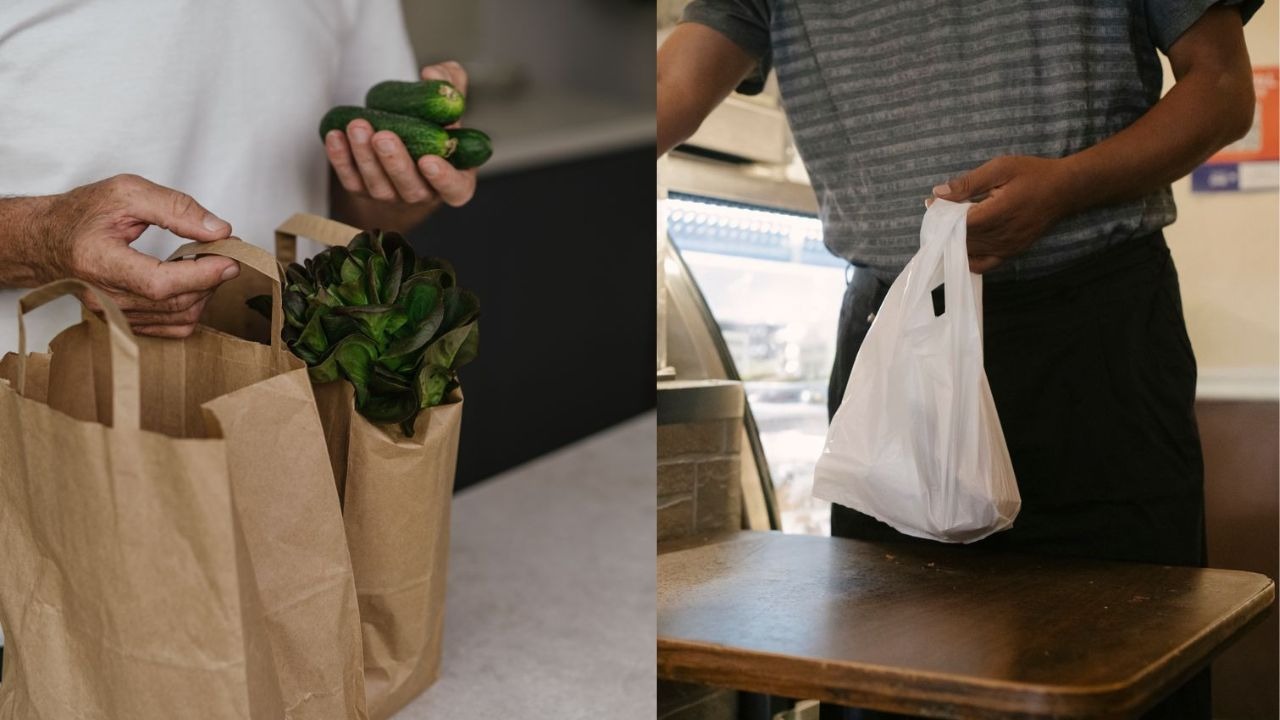
You are at the till, the cashier asks paper or plastic, and for a second you hesitate. Paper feels like the responsible answer. It is made from trees, it looks natural, and it does not linger in hedgerows the way a plastic bag does. Plastic feels like the thing you are supposed to be avoiding. So you pick paper, feel a small flicker of doing the right thing, and move on.
It is a reasonable instinct. It is also, according to the life-cycle evidence, more complicated than it first appears. The honest answer is not a clean win for either bag. It depends almost entirely on a factor most of us never think about at the moment of choosing.
Why this small choice is worth understanding
Carrier bags are one of the most ordinary decisions you make. You might handle several a week without a second thought, which is exactly why they are worth thinking about once, properly, so you can stop second-guessing yourself.
There is also a lot of confident, contradictory advice out there. One article tells you plastic is destroying the oceans, the next tells you paper bags are worse for the climate, and a third insists you should be using a cotton tote for everything. It is easy to come away feeling that whatever you choose is somehow wrong. Understanding what the research actually measured, and what it did not, is the fastest way out of that guilt loop. The goal here is not to make you feel bad about a bag. It is to help you make a choice you can feel settled about.
How the two bags actually differ
To compare them fairly, it helps to follow each bag through its whole life, from raw material to disposal, rather than judging it on how it feels in your hand.
A standard lightweight plastic carrier is usually made from high-density polyethylene, often shortened to HDPE. It is thin, it uses a small amount of material, and it takes relatively little energy and water to produce. That efficiency is its quiet advantage. Its problems come later. If it escapes into the environment, it does not readily break down, and it can persist for a very long time as litter and fragments. The UN Environment Programme highlights plastic bags among the items that contribute to persistent marine and land litter, which is the harm most people picture when they think of plastic.
A paper bag starts from a different place. Making paper is comparatively resource-intensive. It generally takes more raw material, more energy, and more water to produce a paper bag than a lightweight plastic one, and the manufacturing process carries a higher greenhouse gas footprint per bag. Its advantages sit at the end of life. Paper is widely recycled, it is accepted in most kerbside collections, and if it does end up in the open it breaks down far more readily than plastic. So the two bags are almost mirror images. Plastic tends to be cheaper to make and worse to throw away. Paper tends to be costlier to make and easier to deal with afterwards.
What the evidence actually says
Two large government life-cycle assessments are the most useful sources here, and they point to the same underlying lesson even though their headline numbers differ.
The UK Environment Agency published a life-cycle assessment of supermarket carrier bags in 2011. It compared the global warming potential of different bags and asked how many times each would need to be reused to match a single-use HDPE plastic bag used just once. Its finding was that a paper bag needed to be reused roughly three times, a heavier low-density polyethylene "bag for life" around four times, a non-woven polypropylene bag around eleven times, and a cotton bag around 131 times to have a lower global warming potential than that one thin plastic bag. The Environment Agency also noted that reuse is decisive on the plastic side too. It estimated that a large share of lightweight bags, in the order of 40 percent, are reused as bin liners, and that this secondary use meaningfully improves their overall impact. If the plastic bag is reused in that way, the reuse thresholds for the other bags rise further still.
A 2018 life-cycle assessment from the Danish Environmental Protection Agency reached even more striking cotton figures, because it measured differently. Looking at climate change alone, it estimated that a conventional cotton bag needed to be reused around 52 times, and an organic cotton bag around 149 times, to match a single-use plastic bag. But when the Danish researchers widened the lens to include a long list of other environmental indicators, such as water use, ozone depletion, and various forms of toxicity, the numbers climbed dramatically, to thousands of uses for cotton and tens of thousands in the most demanding scenario.
That gap between the two studies is not a contradiction, and it is the single most important thing to take away. The two assessments used different baseline bags and measured different sets of impacts. "Better" is not one number. It depends on which harm you care about most. If your main concern is climate, the picture looks one way. If your main concern is litter and persistence in nature, it looks another. A paper bag can be worse for the climate and better for litter at the same time, and both statements can be true.
The honest trade-off, then, is this. Single-use plastic often has the lower production footprint per bag but the worse litter and persistence problem. Paper carries a higher climate and resource cost to make but is easier to recycle and breaks down more readily. Reusable bags only earn their keep after many uses, and the heavier and more resource-intensive the bag, the longer that pay-off takes.
The genuinely better move
Here is where the evidence becomes reassuring rather than demanding, because the most effective action is also the cheapest and least dramatic.
Use whatever bag you already own, and use it as many times as you reasonably can. Across both studies, and across almost every bag type, the number of reuses matters far more than the material. A cotton tote used twice is a poor climate choice. The same tote used every week for a couple of years is a good one. The bag with the lowest impact is almost always the one already in your cupboard.
A few practical steps follow naturally from that:
Keep a couple of durable bags where you will actually remember them, by the door, in a coat pocket, or in the boot of the car, so reuse becomes the default rather than an intention.
If you end up with a plastic carrier anyway, give it a second job. Reusing it for shopping again, or as a bin liner, is one of the clearest ways to lower its overall impact, according to the Environment Agency.
Recycle paper bags through your kerbside collection when they are worn out, since paper is widely accepted where plastic film often is not.
Resist buying new reusable bags on impulse. Every additional tote you own is a fresh footprint that needs many uses to justify itself.
Common misconceptions worth clearing up
A few beliefs tend to steer people wrong, so it is worth naming them plainly.
The first is that paper is automatically the greener choice. On climate and resource use, the evidence suggests a single paper bag can carry a heavier footprint than a single lightweight plastic one. Paper's real strengths are recyclability and how readily it breaks down, not its manufacturing footprint.
The second is that a cotton tote is always the responsible option. It can be, but only after dozens or, on some measures, many hundreds or thousands of uses. Bought and forgotten, it is one of the higher-impact choices you can make.
The third is that throwing out all your plastic bags today is a positive act. It is not. Discarding usable bags to replace them with something you have decided is greener simply wastes what has already been produced. Using what you own until it genuinely wears out is almost always the lower-impact path.
Frequently asked questions
Are paper bags better for the climate than plastic ones? Not on a single-use basis. Life-cycle assessments from the UK Environment Agency and the Danish EPA suggest a paper bag generally carries a higher greenhouse gas footprint to produce than a lightweight plastic bag. Paper's advantages lie in recyclability and breakdown, not in its climate footprint per bag.
So is plastic actually the environmentally better choice? It has a lower production footprint per bag on several measures, but it also carries the litter and persistence problem that reusable and paper options largely avoid. Whether that trade is worth it depends on which impact you weigh most heavily, and on whether the bag is reused.
How many times do I need to reuse a cotton tote? Estimates vary widely by study and by which impacts are counted. The Environment Agency put it at roughly 131 times to match a single-use plastic bag on climate alone, while the Danish EPA's figures ranged from around 50 times on climate to many thousands when all environmental indicators were included. The practical takeaway is simply to use it for years, not weeks.
Is it worth reusing plastic bags as bin liners? Yes, on the available evidence. The Environment Agency found that reusing lightweight plastic bags, including as bin liners, meaningfully improves their overall environmental performance compared with using them once and discarding them.
Which bag should I choose if I forgot to bring my own? Either works if you commit to reusing it. If you are likely to reuse it for shopping again, the material matters less than the reuse. If you will only use it once and it might end up as litter, paper is the more forgiving choice at the end of life.
Key takeaways
There is no clean winner between paper and plastic, because each is better on some impacts and worse on others.
On production and climate footprint per bag, lightweight plastic often comes out lower; on litter and end-of-life, paper is easier to handle.
Reusable bags, especially cotton, only pay off after many uses, and the numbers vary a lot between studies because they measure different things.
The most reliable way to lower your impact is to reuse whatever bag you already have, as many times as you can.
The lowest-impact bag is usually the one you already own, not a new one you buy to feel greener.
Sources and further reading
Environment Agency (2011), Life Cycle Assessment of Supermarket Carrier Bags: https://assets.publishing.service.gov.uk/media/5a7bff74ed915d01ba1ca7c7/scho0711buan-e-e.pdf
Danish Environmental Protection Agency (2018), Life Cycle Assessment of Grocery Carrier Bags, Environmental Project no. 1985: https://www2.mst.dk/udgiv/publications/2018/02/978-87-93614-73-4.pdf
UN Environment Programme, Plastic pollution and marine litter: https://www.unep.org/topics/ocean-seas-and-coasts/ecosystem-degradation-pollution/plastic-pollution-marine-litter