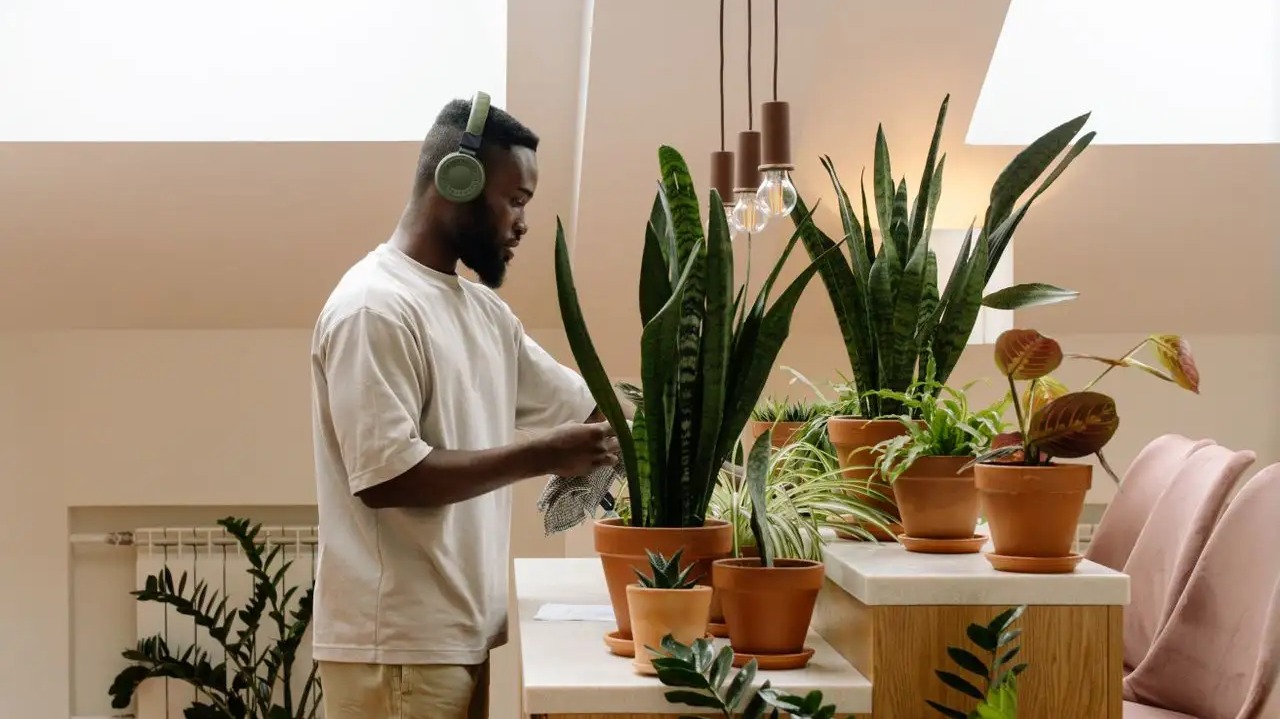
A tidy shelf of leaves and a comforting promise
You buy the peace lily, set it on the windowsill, and read the little care card that came tucked in the pot. It says the plant will purify the air in your bedroom. It feels good to believe. You are adding life to a room and cleaning it at the same time, all for the price of one plant and a bit of watering.
If you have ever paused and wondered whether that promise holds up, you are asking a fair question. The claim is everywhere, repeated on plant labels, in shop displays, and across social media. It sounds scientific because it traces back to a real study by a real space agency. The honest answer is more interesting than the slogan, and it does not require you to love your plants any less.
Why this matters for the air you breathe at home
Most people in many countries spend the large majority of their time indoors, so the quality of indoor air genuinely affects how you feel day to day. Stuffy rooms, cooking fumes, cleaning products, and new furniture can all add small amounts of pollutants to the air inside your home.
That is why the houseplant promise is so appealing. It offers a calm, green, low-effort fix for a real concern. The trouble is that if you rely on a fix that does not do much, you might skip the things that actually work. Understanding what plants can and cannot do helps you spend your attention and money where they make a difference, without giving up the plants you enjoy.
Where the belief comes from: one famous NASA study
The idea did not appear from nowhere. It comes largely from a 1989 study led by the scientist B. C. Wolverton at NASA, carried out with the Associated Landscape Contractors of America. The research had a specific and unusual goal. NASA wanted to know whether plants could help clean the air in sealed environments such as space stations, where you cannot simply open a window.
In the experiments, researchers placed common houseplants inside small sealed chambers, often around one cubic metre or smaller. They injected a single volatile organic compound, one of the gases that can be given off by materials and products, then measured how the concentration fell over hours or days. The plants tested included familiar names such as the snake plant, peace lily, English ivy, and various dracaenas. The compounds studied included benzene, formaldehyde, and trichloroethylene.
Inside those sealed boxes, the plants did remove some of the test gases. That result is real, and it is the seed of every "air-purifying plant" label you have seen since. The important detail, often lost along the way, is the setting. A sealed one-cubic-metre chamber is nothing like a bedroom with a door, a gap under it, and a window that occasionally opens. As Michael Waring, one of the researchers who later reassessed this field, put it, this is "an example of how scientific findings can be misleading or misinterpreted over time."
What the evidence actually says when you scale it up
In 2019, two engineers at Drexel University, Bryan Cummings and Michael Waring, took a careful second look. Their review, published in the Journal of Exposure Science and Environmental Epidemiology under the plain title "Potted plants do not improve indoor air quality," gathered a dozen earlier chamber studies spanning about thirty years and translated their results into a single fair measure.
That measure is the clean air delivery rate, or CADR, the standard yardstick used to judge air purifiers. It captures not just whether something removes a pollutant, but how quickly, in a way you can compare against a room's normal air exchange. Many of the original plant studies had not been framed this way, which is part of why their findings were so easy to overstate.
The reassessment found that a single potted plant delivers a very small clean air rate, with a median of roughly 0.023 cubic metres per hour and a wide spread across studies. Set against the air exchange that already happens in a normal building, the plants barely register. The authors calculated that to match the pollutant removal that ordinary ventilation provides, you would need somewhere in the range of 10 to 1,000 plants for every square metre of floor space. The Drexel summary put the practical end of that range at roughly 100 to 1,000 plants per square metre to rival a building's ventilation, "or even just a couple of open windows."
Picture that for a moment. A modest bedroom might be ten or twelve square metres. Matching what a cracked window does could mean packing the floor with hundreds or thousands of plants, wall to wall, with no room left for a bed. In Waring's words, "plants are great, but they don't actually clean indoor air quickly enough to have an effect on the air quality of your home or office environment."
Here is the fair and important nuance. This does not mean the plants do nothing at all. In a sealed lab box, they measurably removed gases. It means the effect is so small relative to the air movement in a real, lived-in room that it makes no meaningful difference to what you breathe. It is a bit like trying to cool a house by leaving the fridge door open. There is a real effect in principle, but it is swamped by everything else going on.
It is worth adding that plants earn their place in a home for other reasons. The same researchers suggested future work should look at wellbeing rather than air cleaning, and a body of research links indoor greenery to better mood and a sense of calm. Enjoying a room full of leaves is a good reason to keep them. Expecting them to filter your air is where the evidence runs out.
What genuinely improves indoor air
If plants are not the tool for the job, what is? The United States Environmental Protection Agency describes three basic strategies, and they are far more effective than any windowsill jungle.
Control the source first. The EPA notes this is usually the most effective and most cost-efficient approach. It means reducing pollution at its origin rather than trying to clean it up afterwards. In practice that can mean using an extractor fan or opening a window when you cook, choosing lower-emission paints and furnishings where you can, keeping damp and mould in check, and not letting anyone smoke indoors.
Bring in fresh air. Ventilation dilutes indoor pollutants with outdoor air. Opening windows and doors when the outdoor air is reasonable, running kitchen and bathroom extractor fans, and, in some newer homes, using a mechanical ventilation system all raise the air exchange rate. This is the very thing the 2019 review measured plants against, and it wins easily.
Filter the air where needed. A well-chosen air purifier or a good filter in a heating and cooling system can capture fine particles, which is helpful if you have allergies, live near heavy traffic, or face wildfire smoke. Two honest limits apply. A filter only works if enough air actually passes through it, and standard air cleaners are generally not designed to remove gaseous pollutants, only particles. So filtration supports source control and ventilation, it does not replace them.
None of this is dramatic. Opening a window and running the cooker hood are unglamorous habits. They are also what the evidence supports.
Common misconceptions to avoid
"The NASA study proved plants clean my home." - The study showed removal inside small sealed chambers built to mimic a spacecraft, not an open room. The researchers behind the later review were clear that the chamber results do not transfer to normal buildings.
"More plants will fix it." - The numbers do not scale kindly. Reaching the effect of ordinary ventilation could require hundreds of plants per square metre, which is not realistic in a home.
"A single 'air-purifying' species is special." - No houseplant has been shown to clean a real room's air at a useful rate. The labels lean on chamber studies, not on how plants behave in your living room.
"If plants do not purify the air, they are pointless." - Not at all. They can lift mood, add calm, and make a space more pleasant. That is a genuine benefit, just a different one.
"An air purifier removes everything." - Filters mainly capture particles, and only when enough air flows through them. They do little for gases, which is why reducing the source and ventilating still matter most.
Frequently asked questions
So houseplants do nothing for air quality at all? In a sealed laboratory chamber they remove some pollutants, so the effect is not zero in principle. In a normal home, the amount is so small next to everyday air exchange that researchers describe it as having no meaningful effect on the air you breathe.
Are some plants much better than others? Different species removed different amounts in the chamber studies, but even the strongest performers fall far short of what a room's ventilation does. No single species is a shortcut to cleaner indoor air.
Should I get rid of my houseplants then? There is no reason to. This piece is not against houseplants. Keep them for the pleasure, the greenery, and the calm they bring. Just do not count on them as your air-cleaning strategy.
What is the single most useful thing I can do? Where you can, tackle the source of a pollutant and let in fresh air. Ventilating while cooking or cleaning, and reducing what pollutes in the first place, does far more than any number of plants.
Do air purifiers actually work? A good filter can reduce airborne particles, which helps with allergies, traffic pollution, or smoke. Its effect depends on how much air passes through it, and most are not built to remove gases, so it works best alongside source control and ventilation.
Key takeaways
The "plants clean the air" belief traces to a 1989 NASA study by B. C. Wolverton, done in small sealed chambers to explore air cleaning for spacecraft.
A 2019 review by Cummings and Waring, published in the Journal of Exposure Science and Environmental Epidemiology, reassessed a dozen studies and found the effect negligible in real rooms.
To match the pollutant removal of normal ventilation, you would need roughly 10 to 1,000 plants per square metre of floor space, which is not practical in a home.
What genuinely helps is controlling pollutant sources, ventilating with fresh air, and, where needed, proper filtration for particles.
Houseplants still offer real wellbeing and mood benefits, so enjoy them freely, just not as air purifiers.
Sources and further reading
Cummings, B. E. and Waring, M. S. (2019), "Potted plants do not improve indoor air quality: a review and analysis of reported VOC removal efficiencies," Journal of Exposure Science and Environmental Epidemiology. https://www.nature.com/articles/s41370-019-0175-9
Drexel University news, "Study: Actually, Potted Plants Don't Improve Air Quality" (2019). https://drexel.edu/news/archive/2019/november/potted-plants-do-not-improve-air-quality
Wolverton, B. C. et al. (1989), "A study of interior landscape plants for indoor air pollution abatement," NASA. Overview: https://en.wikipedia.org/wiki/NASA_Clean_Air_Study
United States Environmental Protection Agency, "Improving Indoor Air Quality." https://www.epa.gov/indoor-air-quality-iaq/improving-indoor-air-quality
ScienceDaily summary of the 2019 review. https://www.sciencedaily.com/releases/2019/11/191106114202.htm