Listen to this article
In a hurry? Here's the whole article in 5 minutes of audio.
When the label promises more than the bin can deliver
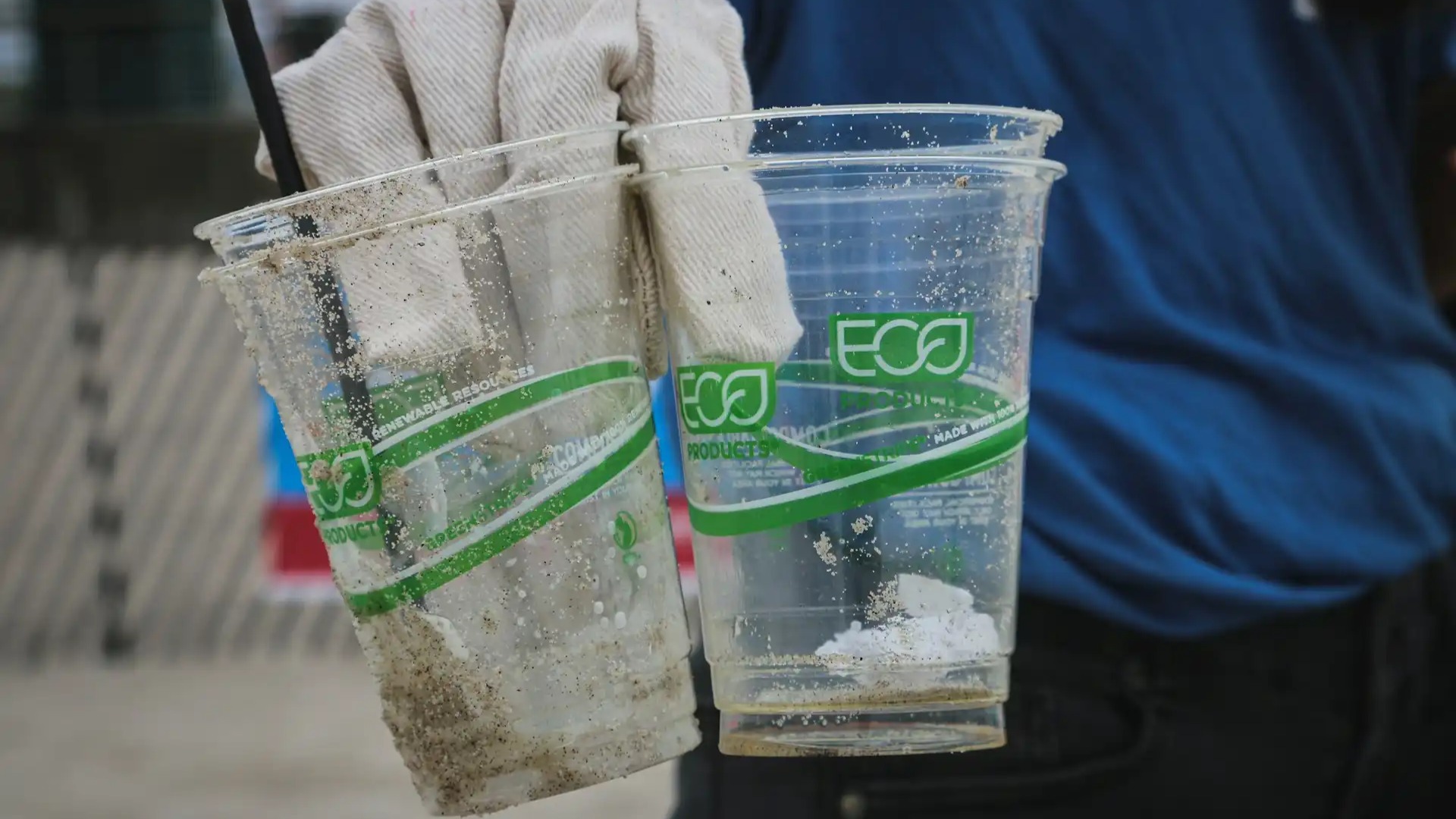
You buy a salad in a clear container marked "compostable," feel a small flicker of relief, and drop it into your home compost heap on the way past. Weeks later, you turn the pile and there it is: the same container, cloudy but intact, apparently unbothered by the whole process.
If that has happened to you, you are not doing anything wrong, and the label is not necessarily lying. The word "compostable" carries a specific technical meaning that is easy to miss on a busy shopping trip. It usually describes what a material can do under particular conditions, not what will happen in your garden or your general waste. Understanding that gap is the difference between disposing of these products well and accidentally making things worse. This article is written for readers who want the precise version rather than the reassuring one.
Why this matters in everyday life
Compostable packaging is now common on food containers, caddy liners, coffee cups, produce bags, and cutlery. It feels like an easy win, and many people treat it as one. Research from WRAP, the UK sustainability charity, found that 77% of citizens believe compostable plastic is better for the environment than other packaging, though WRAP is careful to point out that this belief runs ahead of what these materials reliably do in practice.
The everyday problem is disposal. A compostable item only delivers its intended benefit if it reaches the right place. If it slips into your plastic recycling, it can act as a contaminant, because it is chemically different from conventional plastics and is not designed to be recycled alongside them. So the question is not only whether these products are "good," but whether the system around you can actually process them. That part is often left off the label.
Compostable, biodegradable, and bio-based are three different things
These three words are used interchangeably in marketing, but they describe different properties, and mixing them up is the root of most confusion.
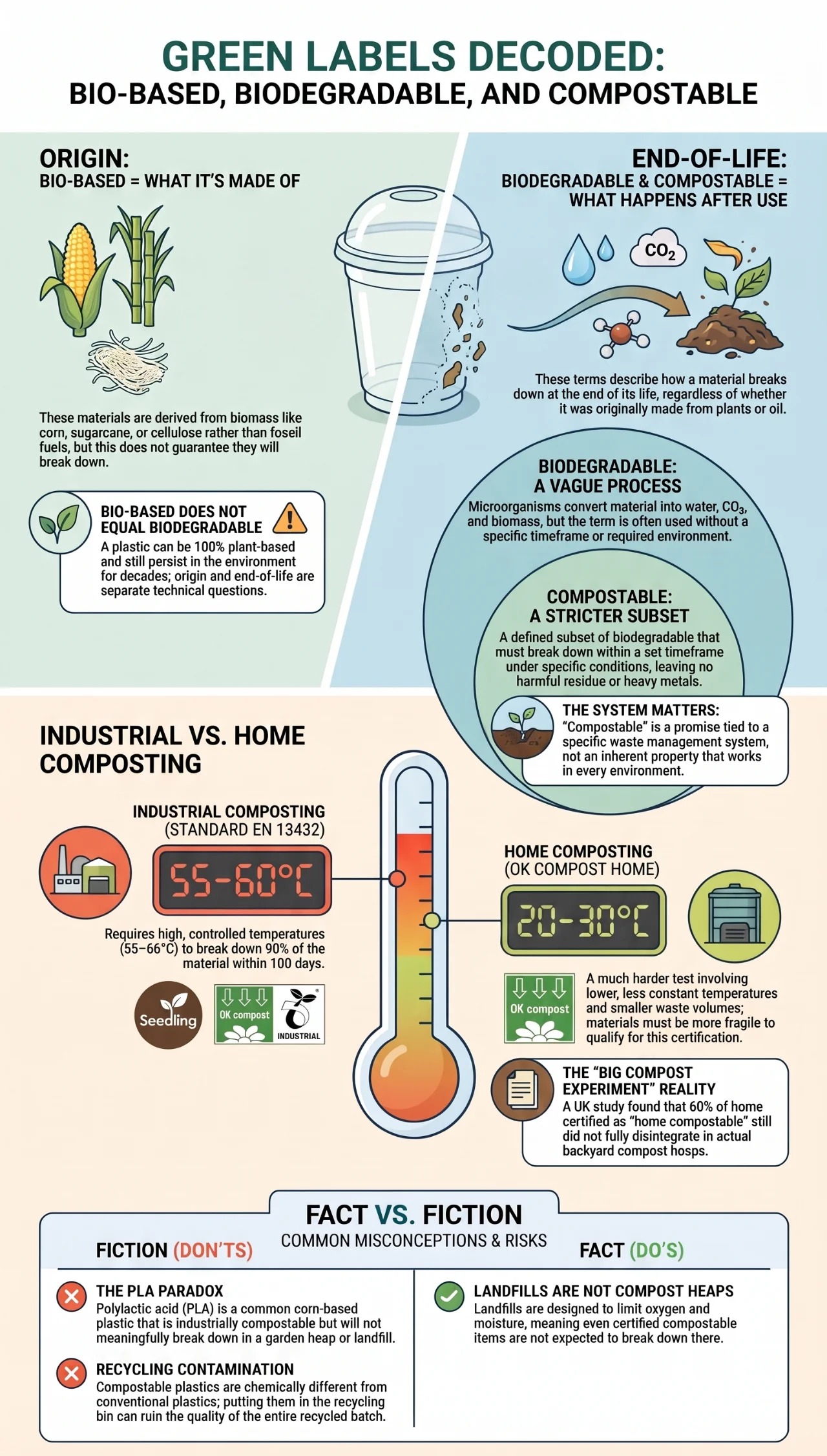
Bio-based refers to where a material comes from. According to European Bioplastics, a bio-based material is partly or wholly derived from biomass such as corn, sugarcane, or cellulose, rather than from fossil sources. Crucially, this tells you nothing about how the material breaks down at the end of its life. European Bioplastics states plainly that "biobased does not equal biodegradable." A plastic can be entirely plant-based and still persist for a very long time, and a plastic can be fossil-based yet still biodegradable. Origin and end-of-life are separate questions.
Biodegradable refers to end-of-life. European Bioplastics describes biodegradation as a process in which naturally occurring microorganisms convert a material into water, carbon dioxide, and biomass. The important catch is that biodegradation depends on the material's chemical structure and, just as much, on the surrounding conditions such as temperature, moisture, and the microbes present. On its own, the word "biodegradable" says little without stating where and how fast. Almost everything biodegrades eventually. The European Environment Agency notes there is not even a general standard for biodegradation in the marine environment, which is one reason vague "biodegradable" claims deserve caution.
Compostable is a stricter, more specific idea. It is a defined subset of biodegradable. A compostable material breaks down within a set timeframe under defined composting conditions and leaves behind compost that does not harm plant growth. The European Commission notes that compostable plastics typically decompose in industrial composting facilities and first need to be collected. In other words, "compostable" is a promise tied to a particular system, not a property the material carries with it everywhere.
A simple way to hold these apart: bio-based answers "what is it made from," while biodegradable and compostable answer "what happens when you are finished with it."
What the evidence and the labels actually say
Here is the distinction that matters most, and the one most labels blur.
Industrial compostable is the common case
Most items marked "compostable" are certified as industrially compostable, usually against the European standard EN 13432. To meet it, packaging generally has to biodegrade by at least 90% within 180 days, disintegrate so that no more than 10% remains in fragments larger than 2mm after 12 weeks, and pass tests for heavy metals and for toxicity to plant life. These tests are run under controlled industrial composting conditions, which typically hold temperatures around 55 to 60 degrees Celsius. Your compost heap does not reach or hold those temperatures. As the standard's own scope makes clear, EN 13432 applies to industrial composting systems and does not guarantee home compostability.
On packaging, industrial compostability is often shown by a "seedling" logo licensed through European Bioplastics, or by an "OK compost INDUSTRIAL" mark from the certifier TÜV Austria. Germany's DIN CERTCO is another recognised body. These marks are meaningful, but they point to a facility, not a garden.
Home compostable is a separate, stricter certification
Home composting is a different and, in an important sense, harder test. TÜV Austria, which runs the "OK compost HOME" scheme, describes home composting as a slower process at lower and less constant temperatures with smaller volumes of waste. Because the conditions are gentler, a material has to degrade more completely to qualify. Home compostability is its own certification, shown by marks such as "OK compost HOME," and it underpins standards including France's NF T 51800, Australia's AS 5810, and the European EN 17427. If an item does not explicitly carry a home-composting claim, you should not assume it will break down in your bin.
The evidence that this matters is direct. The Big Compost Experiment, a UK citizen science study published in Frontiers in Sustainability in 2022, asked thousands of people to compost plastics at home and report the results. It found that around 60% of items certified as home compostable did not fully disintegrate in participants' compost. The study also found that 46% of the plastic packaging people submitted carried no compostability certification at all, and a further 14% showed only industrial certification, meaning it was never suitable for a home heap in the first place. The researchers concluded that home composting is not currently an effective way to process these plastics in the UK, and that public confusion about the labels is a large part of the problem.
The recycling contamination catch
There is a second, quieter risk. Compostable plastics are not the same polymers as conventional plastics and are not designed to be recycled with them. WRAP's guidance warns against using compostable plastic where it could end up contaminating conventional plastic recycling, because it can degrade the quality of the recycled material and the markets that depend on it. So a compostable cup in your plastics bin is not a harmless mistake. It can undermine the recycling of everything around it.
How to handle these products responsibly
You cannot fix the labelling system, but you can dispose of these items thoughtfully.
Read the label for the specific claim. Look for the exact words. "Home compostable," or an "OK compost HOME" mark, is the only reliable green light for your own compost. "Industrially compostable" or a seedling logo means it needs a commercial facility.
Check what your local council actually accepts. WRAP's own suggested wording asks people to add compostable items to a food or garden waste bin only if the local council accepts them. Many collections do not, so this is worth confirming rather than assuming.
Keep compostable plastics out of your plastic recycling. If you are unsure and no composting route is available, general waste is usually the safer destination than the recycling bin, because it avoids contaminating the recycling stream.
Do not assume PLA breaks down at home. Polylactic acid, or PLA, is one of the most common compostable plastics, often made from corn starch. It is generally certified for industrial composting, not home composting, and it does not meaningfully break down in a typical garden heap or in landfill.
Where you can, reduce reliance on single-use altogether. A reusable item you already own, used consistently, sidesteps the disposal puzzle entirely. This is not about replacing everything at once, but it is worth keeping in view.
Common misconceptions to avoid
"Compostable and biodegradable mean the same thing." They do not. Compostable is a defined, tested subset of biodegradable with a fixed timeframe and a safe end product. "Biodegradable" alone does not tell you where or how quickly.
"If it is plant-based, it will rot away." Being bio-based describes the raw material, not the end of life. Some plant-based plastics are not biodegradable at all.
"Compostable plastic will break down in landfill." Composting needs oxygen, moisture, and the right microbial activity. Landfills are largely designed to limit those conditions, so compostable items are not expected to compost there.
"It says compostable, so it belongs in the recycling." It does not, and putting it there can contaminate conventional plastic recycling.
"Home and industrial composting are basically the same." They are different processes at different temperatures, which is exactly why home compostability is a separate, stricter certification.
Frequently asked questions
Can I put "compostable" packaging in my garden compost? Only if it specifically says home compostable or carries a home-composting certification such as OK compost HOME. Items marked only as industrially compostable are unlikely to break down in a home heap, and the Big Compost Experiment found many certified home-compostable items did not fully disintegrate either.
What is the difference between the seedling logo and OK compost HOME? The seedling logo generally signals industrial compostability to EN 13432, meaning a commercial facility. OK compost HOME signals the stricter home-composting standard. They are not interchangeable.
Is PLA compostable? PLA is usually certified for industrial composting, where higher temperatures are maintained. It is not typically home compostable, and it does not reliably break down in landfill or in the sea.
Does compostable plastic help if my council does not collect it? Its benefit depends on reaching a suitable composting facility. Without a collection route, much of that benefit is lost, which is why checking local acceptance matters before you buy on the strength of the label.
Is compostable plastic always better for the environment? Not automatically. As WRAP notes, most people assume it is, but the outcome depends on the material, the certification, and whether it is actually processed correctly. The full lifecycle, including sourcing, manufacturing, and end-of-life, all matter.
Key takeaways
Bio-based, biodegradable, and compostable are three different things: origin, general breakdown, and defined composting under set conditions.
Most "compostable" items are industrially compostable, tested against standards such as EN 13432, and need high-temperature commercial facilities rather than a garden heap.
Home compostable is a separate, stricter certification, and evidence from the Big Compost Experiment shows even certified items often fail to break down at home.
Compostable plastics can contaminate conventional plastic recycling, so they do not belong in the recycling bin.
Read the exact claim, check what your council accepts, and treat vague "biodegradable" or plant-based labels with healthy caution.
Sources and further reading
European Bioplastics, "Bioplastics" (definitions of bio-based, biodegradable, and compostable): https://www.european-bioplastics.org/bioplastics/
European Commission, Environment, "Biobased, biodegradable and compostable plastics": https://environment.ec.europa.eu/topics/plastics/biobased-biodegradable-and-compostable-plastics_en
European Environment Agency, "Biodegradable and compostable plastics: challenges and opportunities": https://www.eea.europa.eu/en/analysis/publications/biodegradable-and-compostable-plastics-challenges-and-opportunities
TÜV Austria, "OK compost HOME" certification (industrial vs home composting): https://okcert.tuvaustria.com/ok-compost-home-en/
WRAP, "New guidance to address confusion over compostable plastic packaging": https://www.wrap.ngo/media-centre/press-releases/new-guidance-address-confusion-over-compostable-plastic-packaging
WRAP, "Considerations for compostable plastic packaging": https://www.wrap.ngo/resources/guide/considerations-compostable-plastic-packaging
Purkiss et al., "The Big Compost Experiment," Frontiers in Sustainability (2022): https://www.frontiersin.org/journals/sustainability/articles/10.3389/frsus.2022.942724/full
Ellen MacArthur Foundation, "Compostable, biodegradable, and bio-based plastic: what's the difference?": https://www.ellenmacarthurfoundation.org/compostable-biodegradable-and-bio-based-plastic-whats-the-difference