The bird was not going to make it, and Rebecca Hosking knew it.
She was on Midway Atoll, a scatter of coral and sand roughly 1,300 miles north-west of Honolulu, filming albatrosses for a BBC wildlife documentary. Midway is about as far from a supermarket as anywhere on Earth. Yet when the young birds died, and many of them did, their stomachs were full of the things we throw away: bottle caps, lighters, pens, toy soldiers, fragments of the everyday. The adults, ranging out over the Pacific to feed their chicks, had mistaken floating plastic for food and carried it home. Hosking cradled one dying fledgling and, as she later told the Washington Post, "I just broke down crying because I thought she was going to make it."
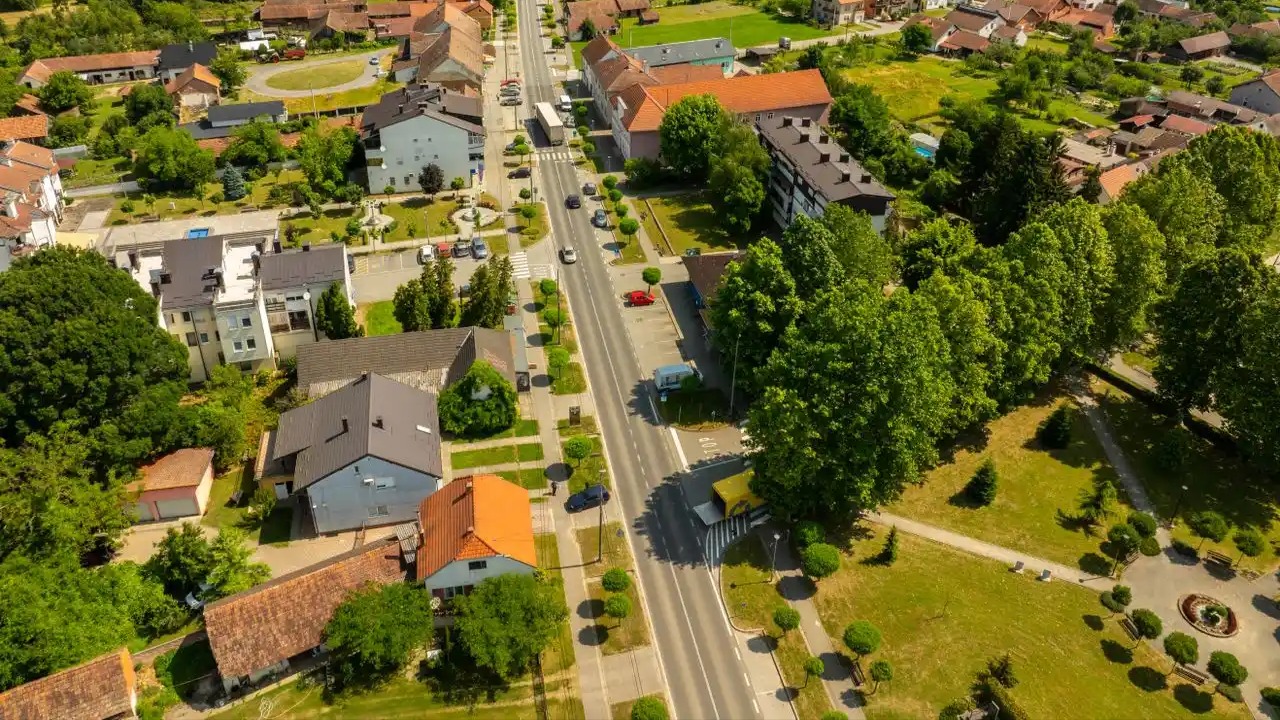
She went home carrying that, back to a town of roughly 1,500 people on the edge of Dartmoor. Modbury is the sort of place with a steep main street, a few dozen independent shops, a butcher, a chemist, a deli. It is not a laboratory for global problems. It was simply where Hosking had grown up, and where, in the spring of 2007, she decided to try something small enough to actually do.
Her film, "Message in the Waves", showed the Pacific she had seen: the albatrosses, the dolphins nosing at plastic bags that drift and pulse in the water like jellyfish. But a film is a thing you watch and then forget by supper. Hosking wanted her neighbours to do something, and the something she chose was almost comically modest against the scale of the ocean. She asked the shops of Modbury to stop handing out plastic bags.
In April 2007 she gathered the town's traders in a local art gallery. Of the forty-three she invited, thirty-seven came. She showed them the footage. She had brought sand from a Hawaiian beach so they could see the plastic ground into it, and she reminded them that the bay at the bottom of their own hill was not as clean as it looked either. Then she made her case, which was less an appeal to guilt than an appeal to consistency. These were people who cared about their town. The bags were a habit, not a conviction. Habits can be changed.
What is striking, looking back, is that nobody banned anything. There was no by-law, no fine, no council enforcement. Modbury's plastic-bag-free status, announced in May 2007 and widely reported as the first of its kind in Britain and in Europe, was a voluntary agreement among shopkeepers who had sat in a room together and decided to try. That is a fragile foundation for a revolution. It is also, perhaps, the only kind that holds, because everyone who kept to it had chosen it rather than been ordered into it.
The shops did not go without bags. That was never the point. Instead they switched: paper bags, sturdy reusable cotton ones for sale by the till, and bags made from cornstarch that were meant to break down rather than linger for centuries. Customers who wanted a carrier could buy one, often for a few pence, and most learned quickly to bring their own. The friction was the feature. A bag you have to think about, or pay a little for, is a bag you use once and then keep using.
Adam Searle, who ran Mackgills delicatessen, put the change in numbers that are easy to picture. He had been handing out something like 150 plastic bags a day. After the switch he was selling only a handful of biodegradable ones. He also said something more honest than most of us manage, admitting to NPR that for years he had felt like a hypocrite, giving out the very thing he privately wished away. That is the quiet engine of the whole story. Modbury did not work because its people were unusually virtuous. It worked because a lot of ordinary people were already uneasy, and someone finally gave them a way to act on the unease together, so that no single shop had to be the awkward one.
And then the thing that small towns are not supposed to do: it spread. Within months, other towns in Britain and Ireland were announcing their own plastic-bag-free ambitions. The story travelled far beyond Devon, into national newspapers and onto foreign radio. Modbury became a kind of proof, a worked example that a community could simply decide to leave a habit behind and not fall apart in the process. When England eventually introduced its 5p charge on single-use carrier bags in 2015, it drew on the harder evidence from Ireland's earlier national levy, but also on a cultural shift that places like Modbury had helped make thinkable. That charge is credited with cutting the number of bags handed out by the big supermarkets by roughly 95 per cent in the years that followed, according to government figures, and the list of banned single-use items has grown since to include straws, stirrers, cotton bud sticks, expanded polystyrene, and, from 2023, many plastic plates and pieces of cutlery.
It would be tidy to end there, with the ripple reaching the sea. But an honest telling has to sit with the harder parts, and there are several.
The first is that a voluntary promise is only as durable as the people keeping it. Shopkeepers retire, leases change hands, a national chain opens on the corner and hands out whatever its head office ships. A town cannot legislate its own memory. What Modbury proved was that the shift was possible and popular, not that it was permanent, and those are different things.
The second is the awkward truth hiding inside those cornstarch bags. "Biodegradable" and "compostable" are not magic words. Many such bags only break down properly in an industrial composting facility, at temperatures a garden heap or a landfill never reaches, and in the wrong setting they can persist much like ordinary plastic while lulling us into feeling we have solved the problem. Swapping one single-use bag for another single-use bag is progress only at the margins. The real gain in Modbury was not the cornstarch. It was the reusable cotton bag brought back week after week, and the simple, repeated act of remembering it.
Which points at the third and largest limit. A plastic bag is a tiny fraction of the plastic in any of our lives, and a smaller fraction still of what reaches the ocean. The bottles, the packaging film, the fibres shed from synthetic clothes, the fishing gear lost at sea: none of that was touched by what happened in a Devon art gallery in 2007. Modbury did not try to live without plastic in any complete sense. It tried to live without one visible, symbolic, everyday piece of it, and even that took a documentary, a public meeting, and the steady goodwill of a few dozen neighbours.
Maybe that is the honest measure of the story, and the reason it is still worth telling nearly two decades on. Modbury was never going to save the albatross on Midway. The distances are too great and the problem too vast for one small town to fix. What it could do, and did, was refuse the excuse that nothing can be done until everything is done. It changed what felt normal on one steep street, and normal is contagious. A shopper who brings a cloth bag in Modbury brings it in the next town too. A charge that seems radical in one place becomes unremarkable, then national, then simply the way things are.
Rebecca Hosking came home from the far side of the ocean unable to unsee a dying bird, and instead of despairing quietly she asked the people around her to change a single habit. They said yes. The bird she held was already beyond saving. The point was never that one town could rescue the sea. The point was that a town could decide, together and out loud, to stop adding to the harm, and then let everyone watching see that the decision cost them very little and left the place they loved a little cleaner. That is not the whole answer. It was never going to be. But it is a real one, and it began with a room full of shopkeepers agreeing to do without something they had never really wanted to give out in the first place.
Related PetalPoko articles
What Actually Happens to Your Recycling After the Truck Leaves
Is "Compostable" Plastic Actually Compostable? What the Labels Mean
Sources and further reading
Washington Post, "A Woman, a Village and a War on Plastic Bags": https://www.washingtonpost.com/wp-dyn/content/article/2008/05/05/AR2008050502223.html
NPR, "Modbury, England, Goes Plastic Bag Free" (21 June 2007): https://www.npr.org/2007/06/21/11253591/modbury-england-goes-plastic-bag-free
Word Forest, "How Modbury Changed Perceptions": https://www.wordforest.org/2023/09/01/how-modbury-changed-perceptions/
The Ecologist, "How to make your town plastic bag free": https://theecologist.org/2009/apr/15/how-make-your-town-plastic-bag-free
plasticisrubbish.com, "Modbury: The Plastic Bag Free Town": https://plasticisrubbish.com/2008/07/02/560/