You stand in front of the coffee shelf, or the café menu, and the labels start to blur. Arabica, Robusta, single origin, dark roast, Fairtrade, shade-grown, oat or dairy. Each word promises something, and none of them quite tells you what you are actually choosing. If you have ever wondered whether any of it matters, either for the taste in your cup or for the land it came from, you are asking exactly the right question.
This is a one-stop guide to what "type of coffee" really means, because the phrase hides several different things. Coffee can mean a bean species, a roast level, a growing method, a drink on a menu, or a way of brewing at home. Each of those layers shapes flavour, and each one shapes the environmental cost differently. By the end, you will be able to read any coffee label with confidence, and you will have an honest answer to the question everyone eventually asks: which coffee is the most sustainable.
Why this matters in everyday life
Most people drink coffee almost every day, often more than once. That repetition is the point. A small daily choice, repeated over years, adds up in a way that a one-off purchase never does, both for the pleasure of a better cup and because the details genuinely change the footprint.
Here is the reassuring part. As you will see, the biggest levers are not exotic or expensive. They tend to be simple habits, like how much coffee you use, how much water you heat, and what you pour in. You do not need to overhaul your routine to make a difference, and you certainly do not need to feel guilty about your morning cup.
The different ways we say "type of coffee"
When someone says "what type of coffee is that," they could mean five quite different things:
The species of the plant (Arabica, Robusta, and two lesser-known cousins).
The roast level (light, medium, or dark).
The growing and sourcing method (sun-grown, shade-grown, organic, and the various certifications).
The drink in the cup (espresso, latte, cold brew, and so on).
The brewing format at home (filter, French press, pods, or instant).
We will take them in that order, from the plant to the cup, and then bring the sustainability threads together at the end.
Bean species explained
Almost all the coffee you drink comes from just two species, with two rarer ones making up the remainder.
Arabica
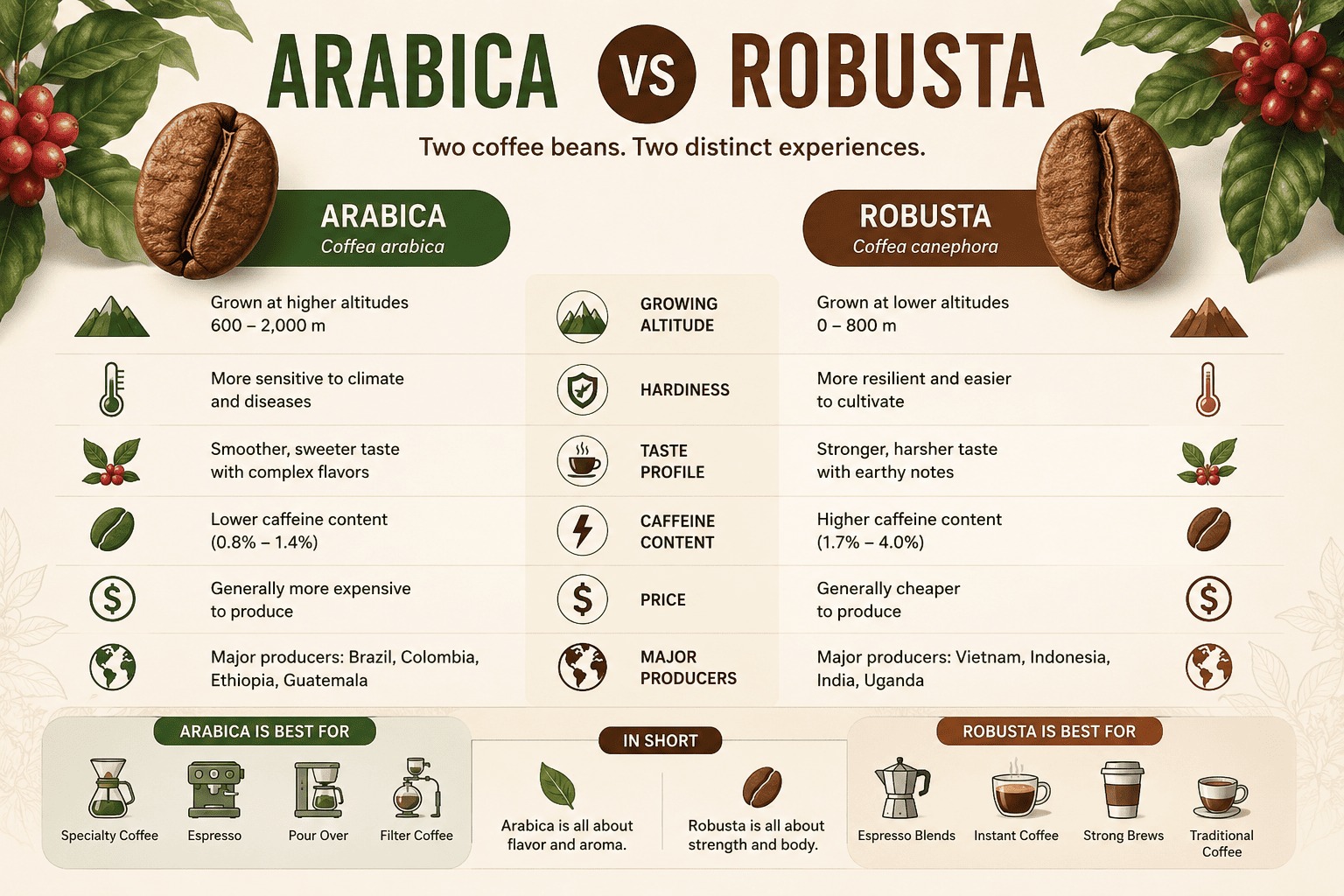
Arabica is the dominant species, making up roughly 60 per cent of global production, according to industry sources such as Genuine Origin. It grows at higher altitudes in cool, relatively wet conditions, and it matures slowly, which is generally credited with its sweeter, more acidic, and more complex flavours. Those are the fruity, floral, and chocolatey notes that specialty coffee tends to celebrate.
The trade-off is fragility. Arabica plants are more susceptible to disease, particularly coffee leaf rust, and to heat and pests. Their caffeine content is relatively low, commonly cited at around 0.8 to 1.4 per cent by weight (roughly 1.2 per cent on average), based on lab comparisons collated by sources like Caffeine Advisor.
Robusta
Robusta accounts for most of the rest, around 40 per cent of production, and its share is growing. As the name hints, it is hardier: it tolerates lower altitudes, hotter climates, and irregular rainfall, and it resists disease better. It also yields more per plant. That resilience partly comes from caffeine, which the plant uses as a natural pest deterrent, and Robusta carries roughly double the caffeine of Arabica, commonly reported at around 1.7 to 3.5 per cent by weight.
In the cup, Robusta is typically more bitter, earthier, and heavier in body, with lower acidity. It has long been the backbone of instant coffee and of many espresso blends, where it lends a thick crema and a caffeine kick. Together, Arabica and Robusta make up around 99 per cent of the coffee grown worldwide.
Liberica and Excelsa
The remaining one per cent belongs mainly to Liberica and Excelsa. Liberica produces large, irregular beans and grows well in hot lowland conditions, mostly in the Philippines, Malaysia, and parts of West Africa. Its flavour is often described as bold and divisive, ranging from fruity and floral to smoky and woody.
Excelsa is often classified as a variety of Liberica rather than a separate species, and tends to bring more tartness, fruitiness, and complexity. Both remain niche, but they attract interest partly because they may cope better with warmer climates as growing regions face rising temperatures. Treat that as a promising possibility rather than a settled solution.
Roast levels explained
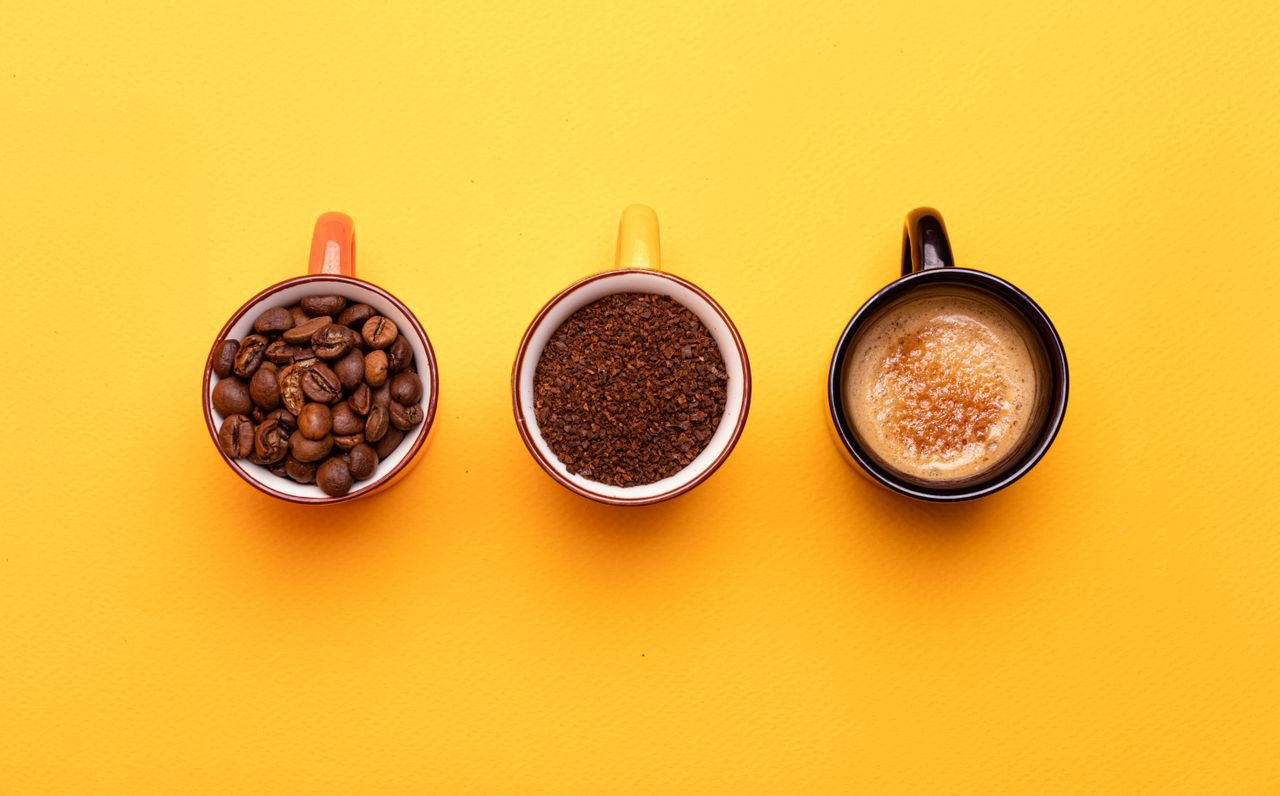
Roasting is where the green, grassy raw bean becomes the brown, aromatic thing you recognise. The roast level describes how far that process goes.
Light roast: stopped around or just after "first crack." The beans are denser and drier on the surface, with brighter acidity and more of the origin's distinctive character preserved. Think fruit, florals, and tea-like clarity.
Medium roast: a balance point. Some origin character remains, but rounder, sweeter, caramel-like notes develop from the roasting itself. This is the most common everyday roast.
Dark roast: taken further, until oils migrate to the surface and the beans look shiny. The flavour becomes bolder, more bitter, smoky, and roast-forward, while the delicate origin notes fade. This is the classic profile of many espresso and traditional "strong" coffees.
One popular belief is worth correcting gently. Roast level has only a small effect on caffeine. The difference people notice usually comes from how coffee is measured. Roasting drives off moisture and mass, so if you measure by scoop, darker beans can pack slightly more in per spoon, while if you weigh them, lighter beans have a marginal edge. Either way, the gap is minor compared with how much coffee you use and how you brew it.
How it is grown, and the certifications
This is where flavour gives way to sustainability, and where the labels multiply. Two ideas underpin most of it: how the coffee is grown, and how it is certified.
Sun-grown versus shade-grown
Traditionally, coffee grew under a canopy of taller trees. From the 1970s onward, many farms shifted to sun-grown systems: coffee planted in the open, often in dense rows, which raises yields but usually depends on more fertiliser and pesticide, and offers far less habitat.
Shade-grown coffee keeps that canopy, and the evidence for its ecological value is reasonably strong. Research summarised by the Smithsonian Migratory Bird Center links shade-grown farms to greater bird diversity and better habitat, describing well-managed shade farms as close to natural forest for many species. The caveat, noted in studies such as one covered by Mongabay, is that shade coffee supports many birds but not all, and it is not a full substitute for intact forest.
The main certifications, and their limits
Certifications try to signal responsible sourcing, but each covers different ground, and none does everything. According to the certification guide maintained by Coffee & Conservation, and analysis from groups like the Corporate Accountability Lab, the honest picture is this:
Fairtrade focuses on economics: a guaranteed minimum price plus a premium that cooperatives invest democratically. Its environmental standards are relatively generic, and it does not require shade or organic methods.
Rainforest Alliance covers a broad range of ecological and social criteria through a score-based system, but it does not mandate shade trees, and a labelled product may contain less than 100 per cent certified coffee.
Organic means roughly three years without prohibited synthetic pesticides or fertilisers. That can reduce chemical inputs, but it does not by itself address shade, biodiversity, or fair pay.
Smithsonian Bird Friendly is the strictest habitat standard. It requires organic certification plus a minimum of around 40 per cent shade cover and a set number of native tree species, which is why it is often called the true shade-grown label.
The limitation shared by all of them is that certification costs money and effort, audits are imperfect, and a label tells you that certain criteria were met, not that a coffee is flawless. Some critics argue the schemes deliver less for farmers than their marketing implies. A certification is a useful signal, then, not a guarantee, and it is most meaningful when you understand what that specific label actually checks.
The popular drinks explained
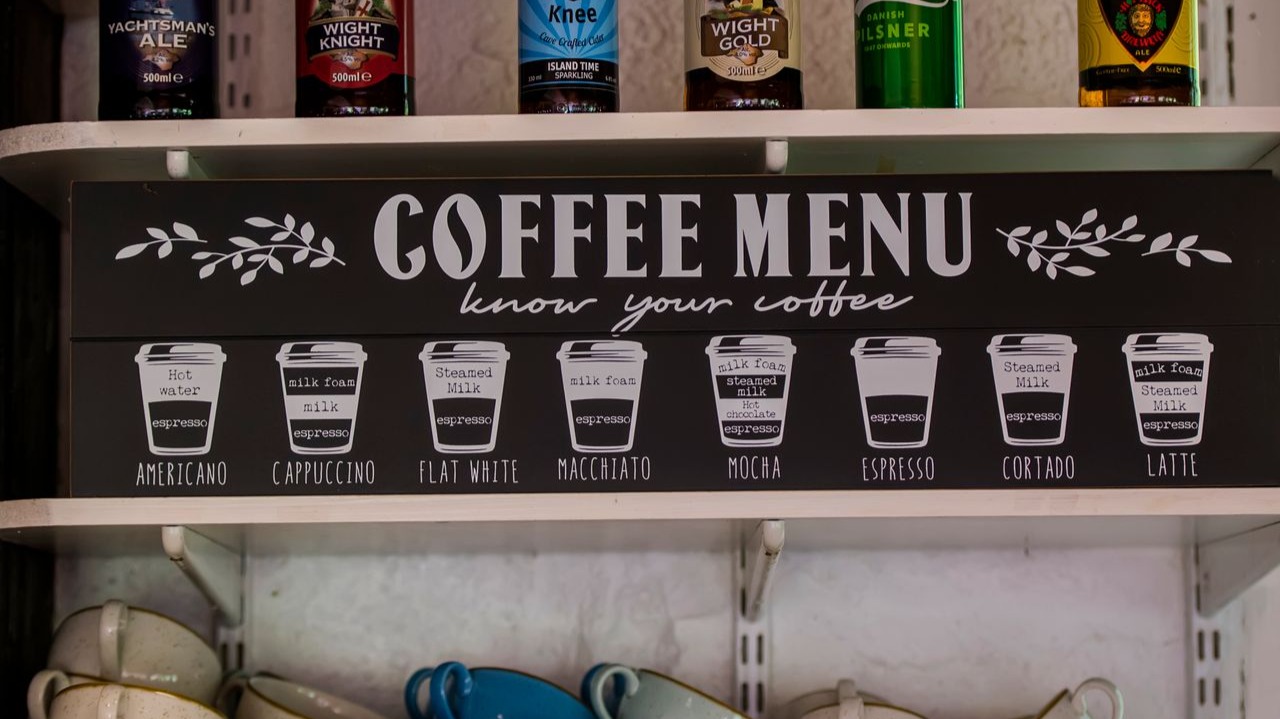
Once the beans are roasted, the drink itself is mostly a matter of ratios: coffee, water, and milk. Here are the common ones, briefly.
Espresso: a small, concentrated shot made by forcing hot water through finely ground coffee under pressure. The base for most café drinks.
Americano: espresso diluted with hot water, closer in strength to filter coffee.
Latte: espresso with a larger amount of steamed milk and a thin layer of foam. Mild and milky.
Cappuccino: espresso with roughly equal parts steamed milk and thick foam, so it tastes more strongly of coffee than a latte.
Flat white: espresso with steamed milk and only a thin layer of microfoam, smaller and stronger than a latte.
Cortado: espresso cut with a roughly equal amount of warm milk.
Macchiato: espresso "marked" with just a little milk or foam.
Mocha: a latte with added chocolate.
Filter or drip: coffee brewed by pouring hot water through grounds in a paper or metal filter. Cleaner and less concentrated than espresso.
Cold brew: coffee steeped in cold water for many hours, giving a smooth, low-acidity result.
Notice that the difference between many of these is simply how much milk you add. That detail turns out to matter a great deal, as the last sections show.
Brewing methods and their footprint
Here the evidence is genuinely useful, and a little surprising. A frequently cited life-cycle analysis led by Luciano Rodrigues Viana at the University of Quebec, reported through The Conversation in 2023, compared four home methods by their greenhouse gas emissions across the whole chain, from farming to disposal.
Measured by the coffee used per cup, the methods lined up like this: traditional filter coffee used the most grounds at about 25 grams, French press about 17 grams, pods about 14 grams, and instant the least at about 12 grams. Filter coffee came out with the largest footprint, partly because it uses the most coffee and partly because of the electricity used to heat and keep the pot warm.
The most important finding sits underneath those numbers. Producing the coffee itself dominates the total impact, accounting for something like 40 to 80 per cent of emissions in that analysis. The researchers noted that roughly 11 grams of Arabica beans can generate around 59 grams of carbon dioxide equivalent, while manufacturing and landfilling a single pod produces around 27 grams. In other words, wasted coffee often costs more than the packaging.
That reframes the usual villain. Pods are widely assumed to be the worst option, and their aluminium or plastic waste is a real problem. But the same study found that because pods portion coffee and water precisely, they can come out ahead of filter or French press once you account for how people actually brew. As the researchers put it, most of us use more coffee than we need and heat about twice the water required, and focusing the debate on pods can hide the more effective ways to cut impact.
The honest takeaway, which is worth attributing to that analysis rather than treating as universal law, is that how you brew and how much coffee and water you use often matter more than the format itself. A wasteful filter habit can lose to a careful pod habit, or beat it, depending entirely on the person. The cleanest move in any format is to brew only what you will actually drink.
The milk factor
If your coffee is black, you can more or less stop worrying at this point. If it is a latte or a flat white, the single biggest part of its footprint is probably sitting in the milk.
The most widely cited evidence comes from a large 2018 study by Poore and Nemecek, published in Science, which analysed data from thousands of farms across many countries. Figures drawn from that work, as summarised by the charity Hubbub, put dairy milk at roughly 3.15 kilograms of carbon dioxide equivalent per litre, compared with about 0.9 for oat, 0.98 for soy, and 0.7 for almond. On that basis, common plant milks generate somewhere around 68 to 77 per cent fewer emissions than dairy. Our World in Data, drawing on the same research, adds that dairy also tends to use around ten times as much land and several times as much freshwater as plant alternatives.
Plant milks are not free of trade-offs, and it is fair to name them. Almond farming can be water-intensive in the specific regions where it is grown, and rice milk tends to score worse than other plant milks on water pollution. But across the headline climate, land, and water measures, the research consistently finds dairy has the higher impact. For a milky coffee drinker, switching some or all of the milk, or simply using less of it, is one of the larger levers available.
So which coffee is the most sustainable, honestly
There is no single most sustainable coffee, and anyone selling you one is overclaiming. Sustainability lives in the combination of choices, not in one magic label. That said, the evidence points fairly clearly to where your attention is best spent.
Based on the studies above, the choices that tend to matter most are, roughly in order: how much milk you use and whether it is dairy or plant-based; how much coffee you use and how much water you heat, rather than the brewing format alone; and how the beans were grown, where shade-grown and credibly certified coffee has the stronger environmental case. The bean species and roast level, by contrast, affect your cup far more than your footprint.
So a reasonable, non-preachy summary is this. A black or lightly milked coffee, brewed carefully without waste in whatever format you will actually use, made from beans with a credible label such as Bird Friendly, and topped up with plant milk or less dairy, covers the meaningful levers. You do not have to do all of it. Even one of those habits, repeated daily, does real work.
Common misconceptions to avoid
"Dark roast has much more caffeine." The roast level barely changes caffeine. How you measure and brew matters far more.
"Arabica is always better and stronger." Arabica is prized for flavour and has less caffeine, not more. Robusta is stronger in caffeine and valued for body and crema.
"Pods are automatically the worst choice." The University of Quebec analysis suggests pods can beat filter or French press once wasted coffee and water are counted, though their packaging waste remains a genuine downside.
"A certification label means the coffee is fully sustainable." Each label checks specific things and misses others. Read it as a signal, not a guarantee.
"Plant milk solves everything." Plant milks generally have a lower footprint than dairy, but they carry their own trade-offs, such as almond's water use, so the honest comparison is relative, not absolute.
Frequently asked questions
What is the difference between Arabica and Robusta in simple terms? Arabica is milder, sweeter, more acidic, lower in caffeine, and harder to grow. Robusta is more bitter, heavier, roughly twice as caffeinated, and hardier. Most specialty coffee is Arabica, while Robusta is common in instant coffee and many espresso blends.
Is instant coffee bad for the environment? Not according to the University of Quebec analysis, which found instant used the least coffee per cup and had among the lowest footprints of the methods tested. The catch is that its quality is typically lower, and much of it is Robusta.
Are coffee pods really that bad? Their aluminium or plastic waste is a real concern, but the same life-cycle research suggests pods are not automatically the worst option, because they portion coffee and water precisely. Recycling or composting them where facilities exist reduces the waste downside.
Which milk is best for a lower-footprint coffee? Based on Poore and Nemecek's data, plant milks such as oat, soy, and almond have markedly lower greenhouse gas emissions than dairy. Oat is often a practical all-rounder, but using less milk of any kind also helps.
Does buying certified coffee actually make a difference? It can, but the effect depends on the specific certification and how well it is enforced. Bird Friendly has the strongest habitat requirements, Fairtrade focuses on price and premiums, and organic focuses on inputs. Treat labels as useful signals to combine, not proof on their own.
Key takeaways
"Type of coffee" spans five things: species, roast, growing method, drink, and brewing format. Each shapes flavour and footprint differently.
Arabica and Robusta make up around 99 per cent of world coffee. Arabica is milder and lower in caffeine, Robusta is stronger and hardier.
Roast level changes flavour a lot and caffeine very little.
Shade-grown coffee has a reasonably strong biodiversity case, and certifications are helpful signals with real limits rather than guarantees.
For milky coffees, the milk is often the largest single part of the footprint, and plant milks generally have a lower impact than dairy.
How much coffee and water you use, and how much milk, usually matter more than the brewing format. Brew only what you will drink.
There is no single most sustainable coffee, but combining a few honest habits does meaningful work without the guilt.
Sources and further reading
Genuine Origin, "A Coffee Roaster's Guide to Coffee Species": https://blog.genuineorigin.com/2023/02/arabica-vs-robusa-and-more/
Caffeine Advisor, "How Much Caffeine in Arabica vs. Robusta?": https://caffeineadvisor.com/best-coffee-beans/how-much-caffeine-in-arabica-vs-robusta/
Smithsonian Migratory Bird Center, "Ecological Benefits of Shade-grown Coffee": https://nationalzoo.si.edu/migratory-birds/ecological-benefits-shade-grown-coffee
Mongabay, "Shade-grown coffee won't support all birds, but adding a forest helps": https://news.mongabay.com/2022/07/shade-grown-coffee-wont-support-all-birds-but-adding-a-forest-helps-study/
Coffee & Conservation, "Quick guide to coffee certifications": https://www.coffeehabitat.com/certification-guide/
Corporate Accountability Lab, "Why Fairtrade International, Rainforest Alliance and Others are Failing Workers and Consumers": https://corpaccountabilitylab.org/calblog/2023/2/1/certification-schemes-why-fairtrade-international-rainforest-alliance-and-others-are-failing-workers-and-consumers
Euronews, "Are coffee pods better for the environment than you thought?": https://www.euronews.com/2023/01/19/are-coffee-pods-better-for-the-environment-than-you-thought-new-research-offers-surprising
Packaging Europe, "Coffee pods have lower carbon footprint than filter coffee, according to new study": https://packagingeurope.com/news/coffee-pods-have-lower-carbon-footprint-than-filter-coffee-according-to-new-study/9296.article
Hubbub, "Is plant milk better for the environment?": https://hubbub.org.uk/milk-stats
Our World in Data, "Dairy vs. plant-based milk: what are the environmental impacts?": https://ourworldindata.org/environmental-impact-milks
Poore, J. and Nemecek, T. (2018), "Reducing food's environmental impacts through producers and consumers," Science: https://www.science.org/doi/10.1126/science.aaq0216